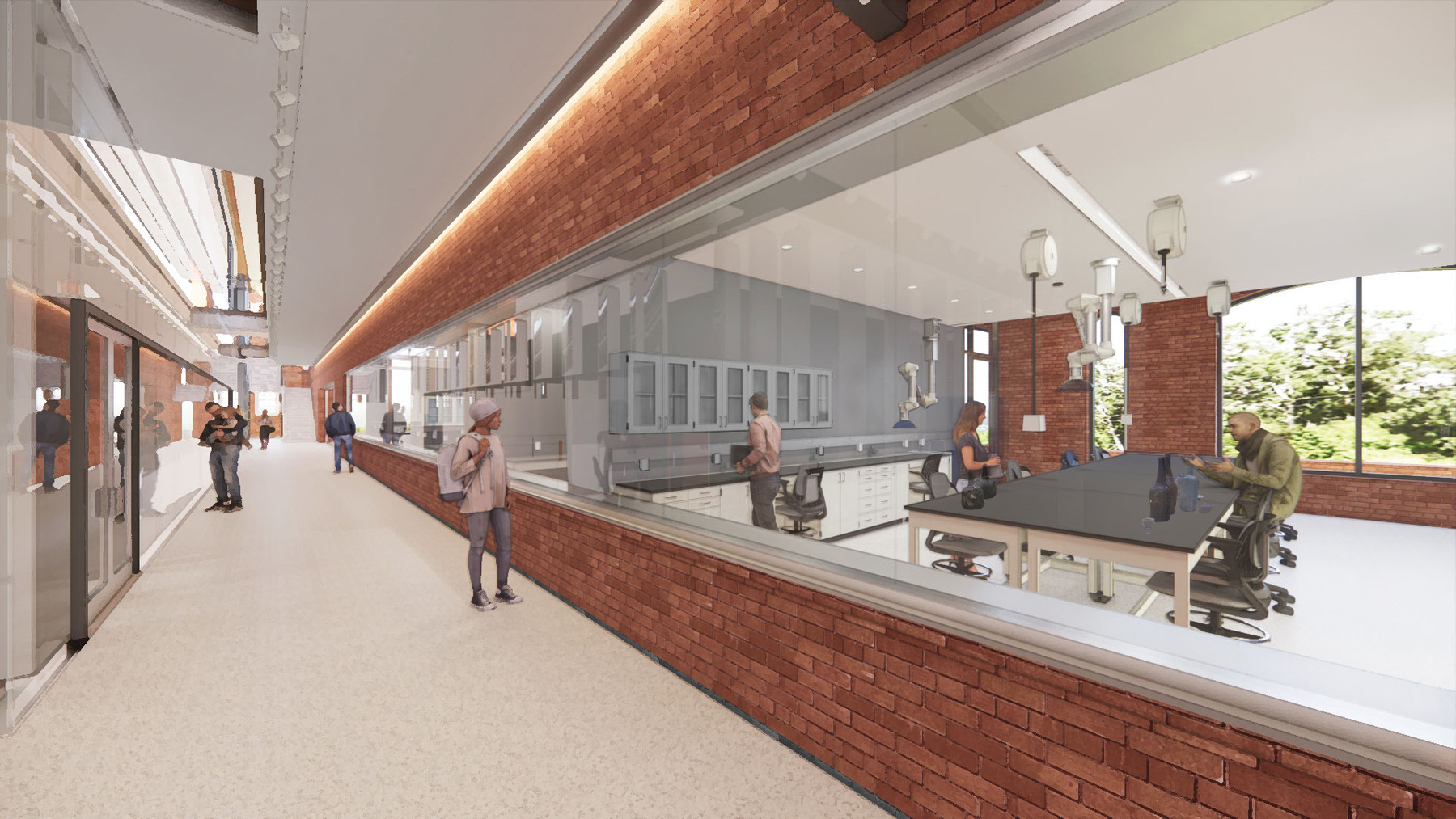
Located in the historic city of Williamsburg, Virginia, the Colin G. and Nancy N. Campbell Archaeology Center features a state-of-the-art museum alongside an active archaeological laboratory. This two-story, innovative facility increases public access and allows visitors to experience the process of transforming discovered artifacts into displayed exhibits. A collaboration between Clark Nexsen and The Colonial Williamsburg Foundation, the archaeology center expands the foundation’s education program and supports its continuous research.
Situated on one of the most active archaeological research sections of Colonial Williamsburg’s historic campus, the design of the building is based on the brick garden walls recognizable throughout the most prominent structures in the historic area, and the 18th-century architecture of the front entrance complements the Art Museums across the street. A blend of old and new, the brick exterior walls are paired with a zinc wall system and glass curtain wall openings.
At 40,000 square feet, the Campbell Center gives archaeologists the space and resources they need to support Colonial Williamsburg as the largest living history museum in the world. The use of brick is carried into the interior and coupled with glass panels, providing views into the building’s state-of-the-art labs and enabling visitors to engage with archaeologists as they clean, catalog, and study artifacts. The labs are equipped with phenolic resin countertops, high-performance drywall, and resinous floors. Wood accents on the second floor and in the archaeologists’ offices bring warmth into the building. Having outgrown their previous workspace, staff have ample room for collaboration in their new offices, which are strategically positioned on the south side of the building to maximize natural light.
As visitors enter the building, they are met with a beautiful two-story glass display case reaching 26 feet high. This display and others throughout the center are protected with museum-grade climate control and afford archaeologists the space to highlight artifacts not currently exhibited. In addition to the lab space where visitors can observe the archeologists at work, a public lab and interior and exterior classrooms provide flexible environments for visitors to participate in hands-on learning experiences. The building itself becomes an educational tool with the design celebrating its unique elements. For example, a glass floor in the main corridor reveals a foundation wall predating previously known structures at the site. Similarly, a well was recreated in the floor using bricks salvaged from its discovery.
The Campbell Archaeology Center is unlike any other in the nation and makes archaeology more accessible. While some archaeology centers offer public access to labs and others display artifacts, the Campbell Center is the only one providing both experiences. This one-of-a-kind facility is a platform for the nearly 60 million archaeological artifacts that have been discovered in Colonial Williamsburg, including the country’s most comprehensive 18th-century collection. Nonetheless, this is likely a small percentage of what is waiting to be unearthed despite almost a hundred years of excavation. Facilitating new discoveries, the Campbell Archaeology Center aids archaeologists in reconstructing a vivid image of life from the past and educating generations.
