Looks Like School Spirit: How Architecture Strengthens Identity
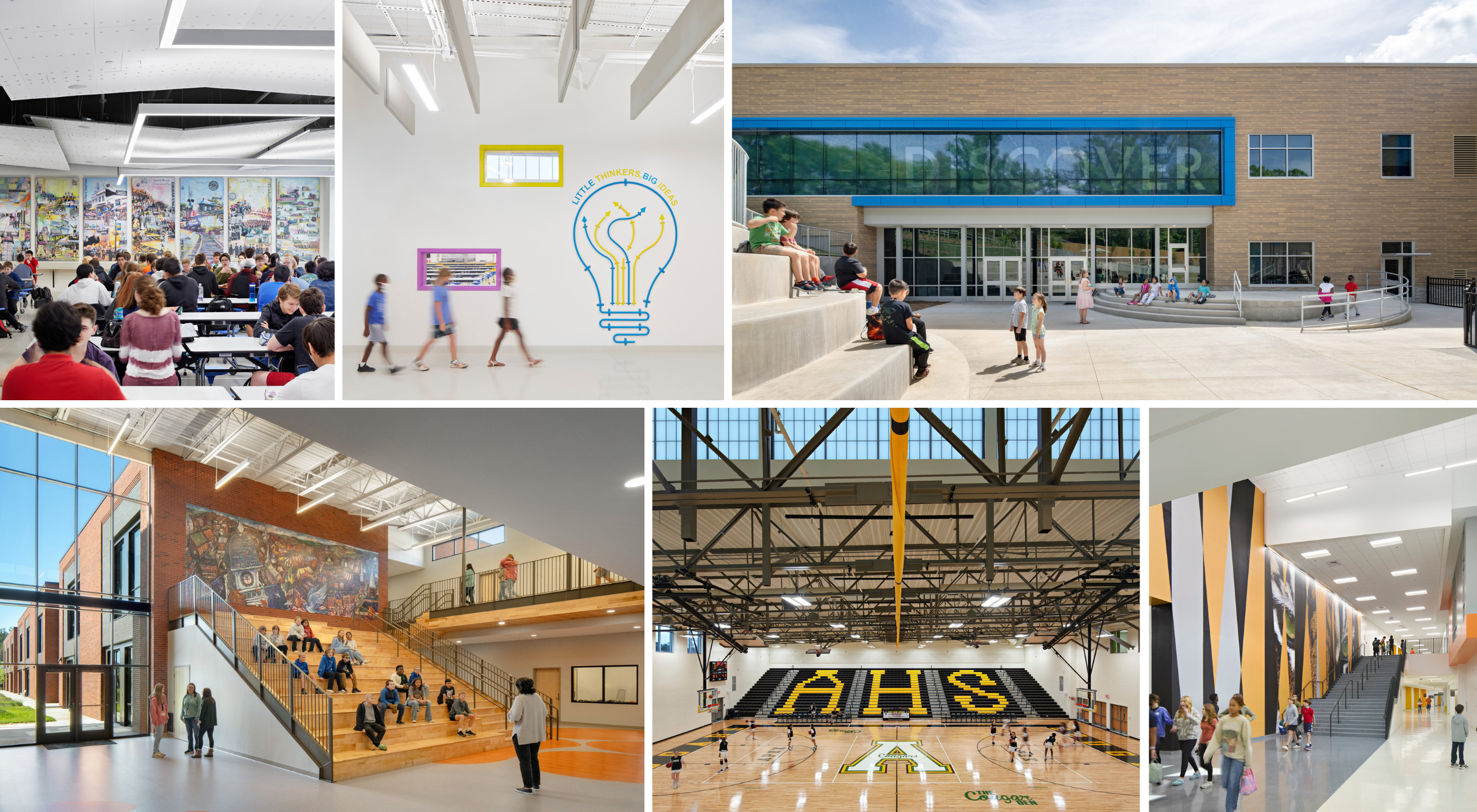 When we think about branding in schools, logos, mascots, and school colors may be the first things that come to mind. While these are perhaps most widely recognized, what students experience most directly in their school are the spaces they use every day to gather and learn. Architecture has the power to shape the identity of the building and indirectly, shape the school community and individuals who spend their time in the school. Design, detail, and material choices reinforce what a school is, what it values, and who belongs there. The examples that follow trace that arc: from creating an identity, to building pride in it, to fostering a genuine sense of belonging.
CREATING AN IDENTITY
Identity starts with intention. As designers, we partner with schools to define that intention. We begin with a series of thoughtful questions:
1. Is an identity already established? For schools with a long history, looking to the past and respecting the growth of the established brand is critical. Alumni who previously attended a school deserve to tie their memories and experiences with recognizable branding. While working on the redesign of Apex High School in Apex, NC, the design team uncovered a link that had been broken. The school’s history includes the early 1970s merger of Apex High School and Apex Consolidated High School, with the color green serving as a symbol of that unified district. Working with school representatives, the team reintroduced green into the color scheme — including a revised logo that appears as an oversized center court feature on the gym floor and embeds history into surfaces students walk across every day.
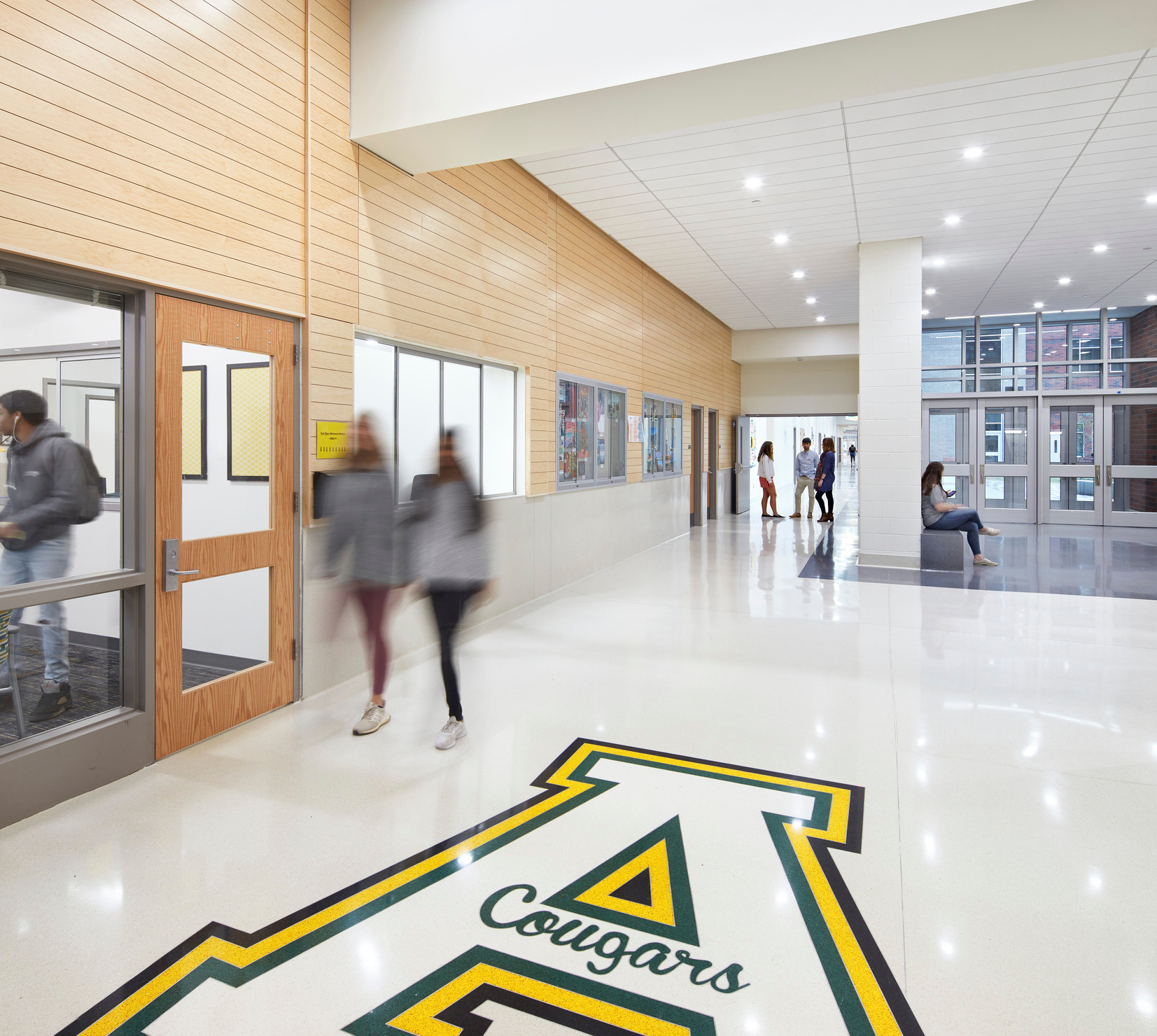
Apex High School’s revised logo is showcased in widely used areas, such as the gymnasium and main entry lobby.
2. Is there a theme or special programming associated with the school? If a school community has an existing identity, it is important to maintain it. At Conn Elementary School in Raleigh, NC, the entrepreneurial magnet theme is reinforced throughout the new building, both in material selection and intentional exposure of building systems. These design choices allow students to see how the building works, which emphasizes the community’s core mission of understanding how things are made. The design team also worked with a local artist to create a large-scale 2D lightbulb out of conduit, enhancing and refining the existing logo for the school community in the replacement facility.
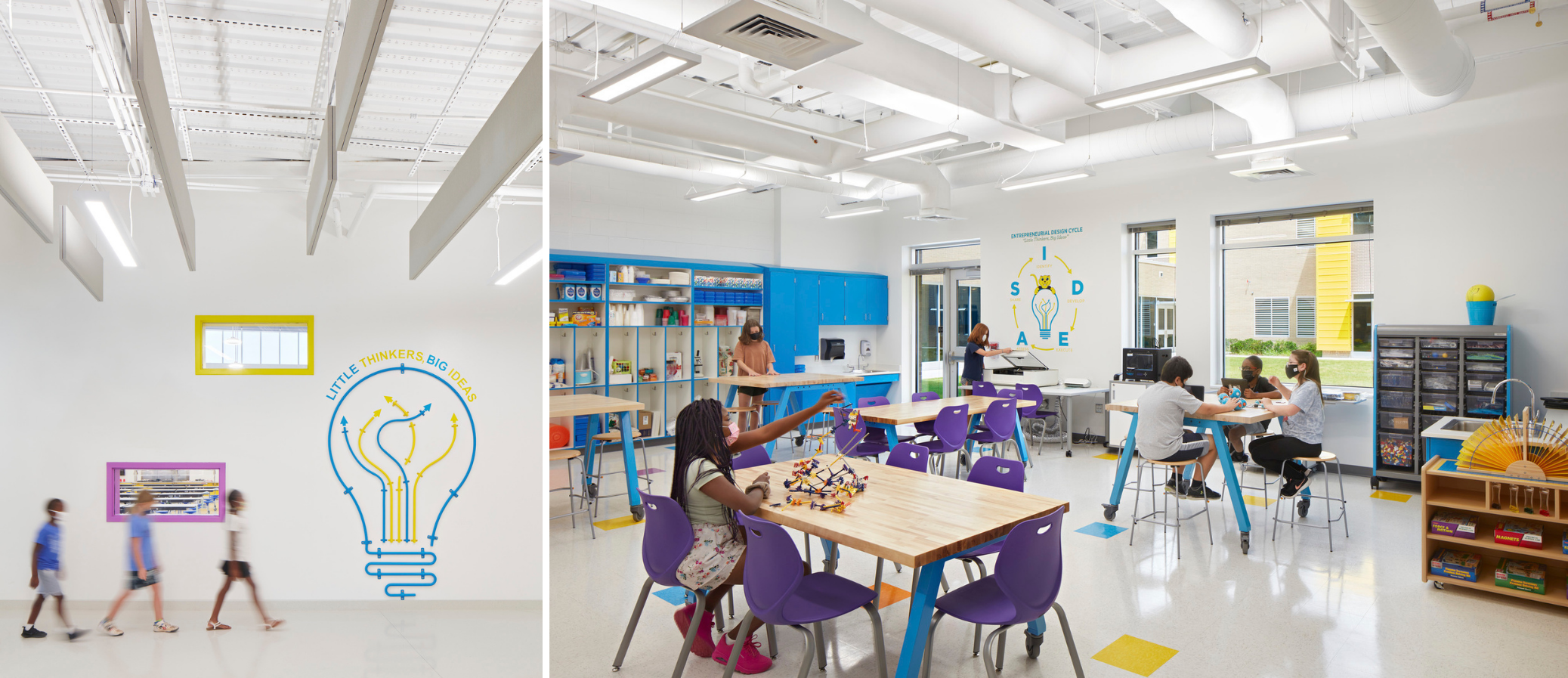
Conn Elementary School’s entrepreneurial magnet theme is reinforced through design, material selection, and the intentional exposure of building systems.
3. What is appropriate for the age of students attending the school? Brands, logos, and mascots should be planned for each grade level and relatable to specific age ranges. Elementary school mascots and branding may be more playful, colorful, and friendlier, while middle and high school branding may become more mature and refined with age and growth. Perhaps most important to consider is branding at the middle school age — this is inherently a transitional time for most students, evolving from single classrooms to traversing multiple classes, time management, and changing social circles. At Fuquay-Varina Middle School in Fuquay-Varina, NC, the school’s tiger mascot takes center stage in the lobby through a large graphic that is a modern interpretation of a tiger hiding in tall grass.
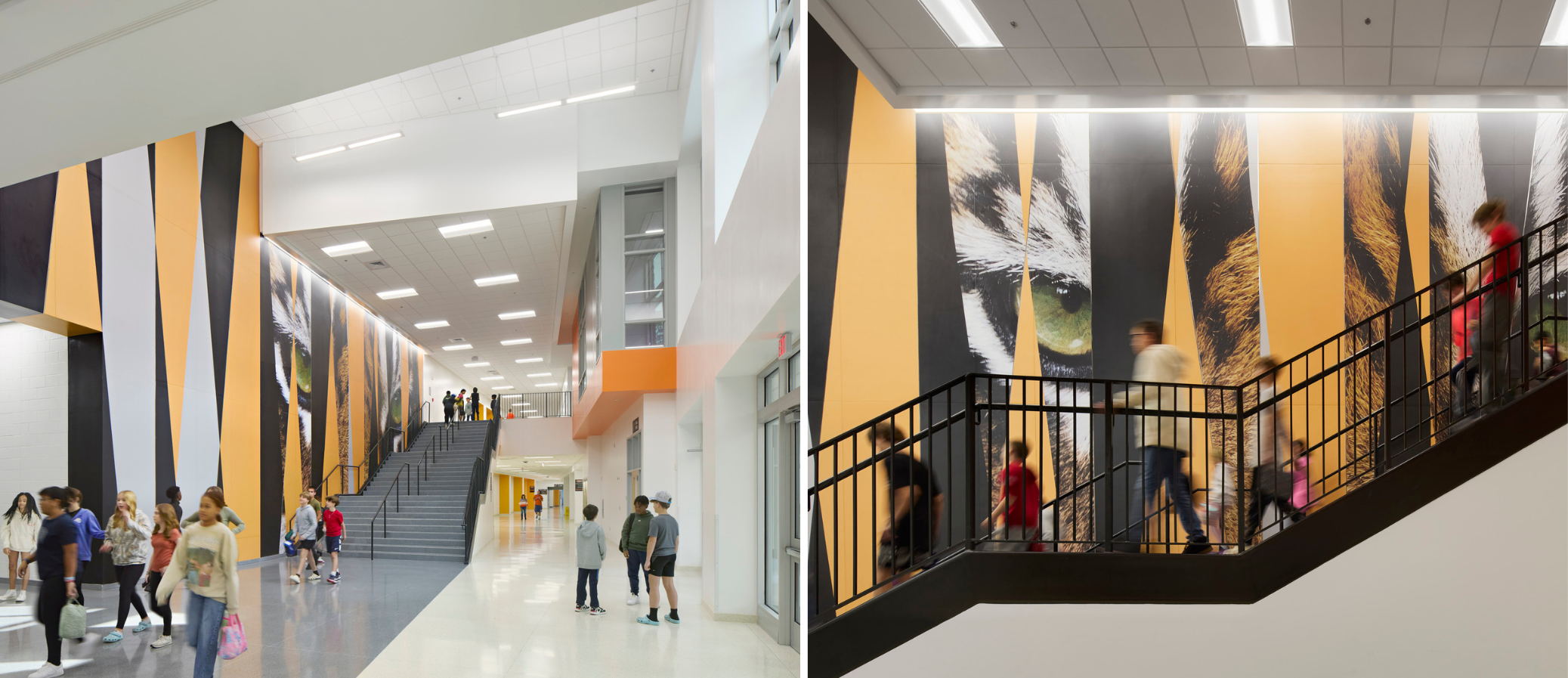
Fuquay-Varina Middle School’s Bengal tiger mascot is larger than life in this student-favorite graphic at the main entry.
4. What is the school’s role in the larger community? Brooks Global Studies in Greensboro, NC, is sited in a residential neighborhood, and exterior branding were important for respecting the surrounding area. Using warm wood material and a natural stone base, the building reflects the existing nature of the heavily wooded neighborhood and the Greensboro Arboretum, which sits directly adjacent. As a global studies magnet school, discovery and exploration are central to Brooks Elementary’s identity. The DISCOVER graphic reinforces this sense of curiosity, adventure, and action toward real-world problems not just to students, but for the larger community.
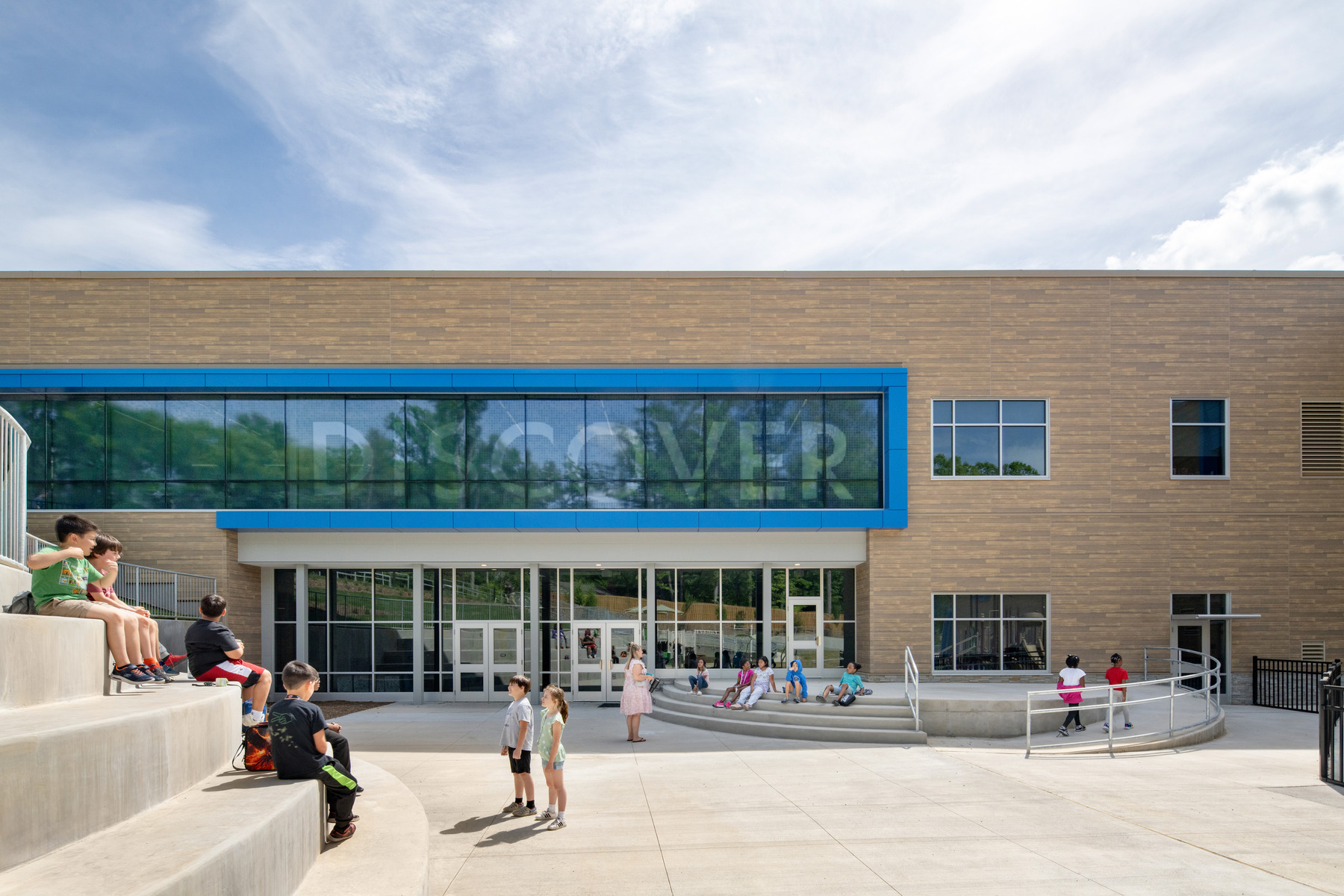
At Brooks Global Studies, material selection respected the local area while reinforcing the school’s mission for discovery and exploration.
PRIDE IN IDENTITY
Once identity is established, design has the power to celebrate and reinforce it. Winston Churchill knew the power of buildings to influence their users when he said, “We shape our buildings and afterwards, our buildings shape us.” The intentional planning and development of branding throughout a building can positively impact students, reinforcing their connection to the school, in turn leading to pride and a sense of value. When branding supports shared experiences, students and teachers alike show increased levels of investment and ownership. Sharing history in branding can be a powerful way to connect generations and share pride in a common idea.
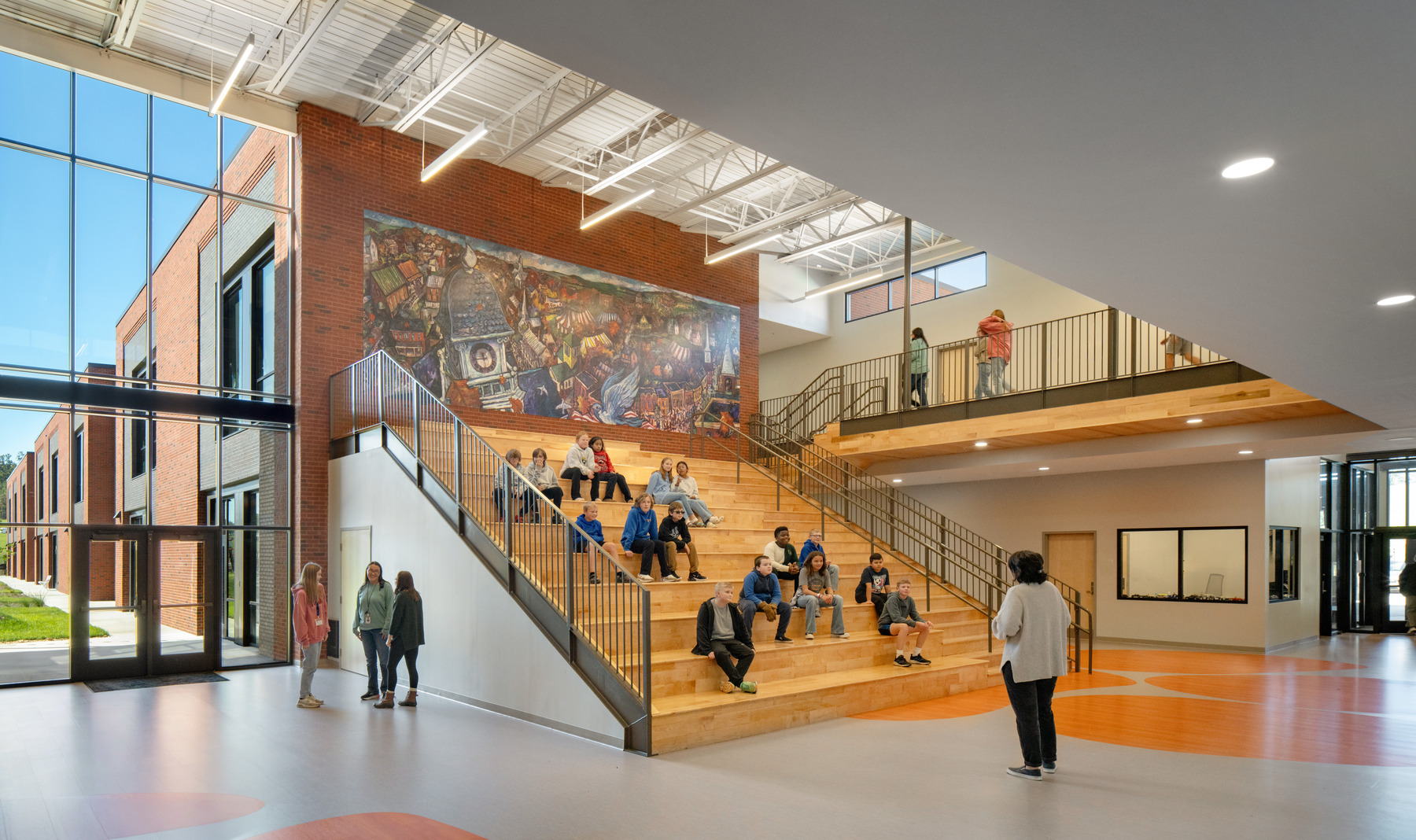
At the top of the “courthouse steps” of Jonesborough Elementary School is a large mural celebrating the town’s history.
The Town of Jonesborough has a distinct identity as Tennessee’s oldest establishment, and the new PK-8 Jonesborough Elementary School design intentionally takes cues from buildings in the existing historic downtown. The “courthouse steps” inside the main entry function as a monumental stair and a gathering place while giving a nod to the town’s civic character. Adjacent to this gathering space is a large mural created by local artists that celebrate the town’s history and bring a renewed sense of pride to users.
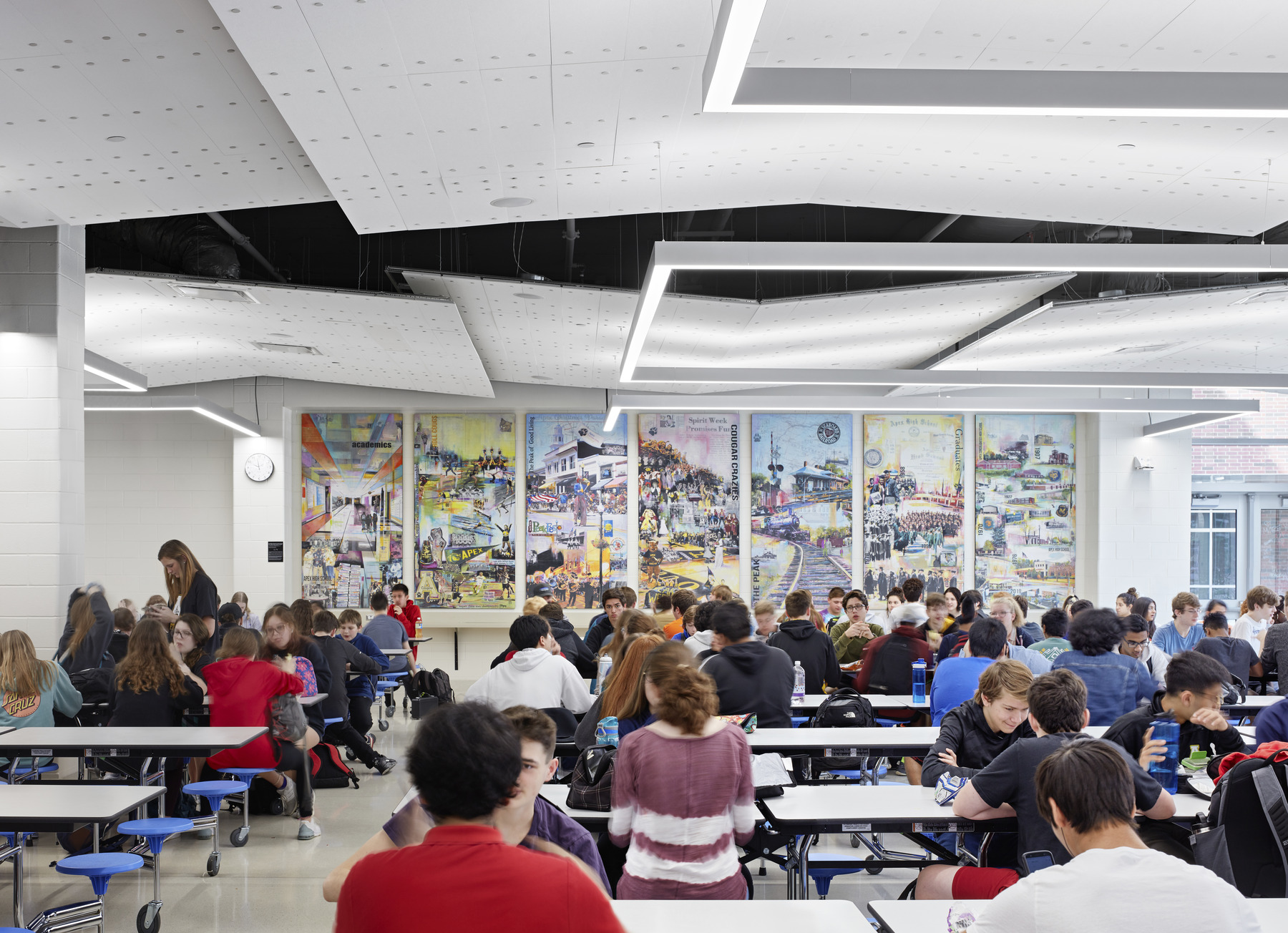
The collaged murals in the cafeteria of Apex High School go beyond school spirit to highlight community and alumni spirit.
Similarly, at Apex High School, large collaged murals flank two sides of the cafeteria. Developed over an entire semester by Apex art students in collaboration with a local artist, the mixed media artwork pulls from artifacts, photographs, and handwritten letters spanning 90-plus years of school history. Having students create the lasting art within the school themselves offers opportunity for ownership in a way a commissioned piece never could.
IDENTITY & BELONGING
When identity is clear and celebrated, something deeper happens: people feel like they’re part of it. The pride built in careful planning and use of branding on school campuses speaks to the second part of Churchill’s wise words, as the building will start to shape the users. This can come in small or large doses, but the subtle inclusion of branding can positively influence the subconscious in a way that nothing else can. While a school devoid of color, logos, or any type of apparent school pride can result in students who are not invested or connected, one with purposeful intention can change the holistic wellness of its users. This sense of belonging can be enhanced by moments, reinforced throughout the facility or campus.
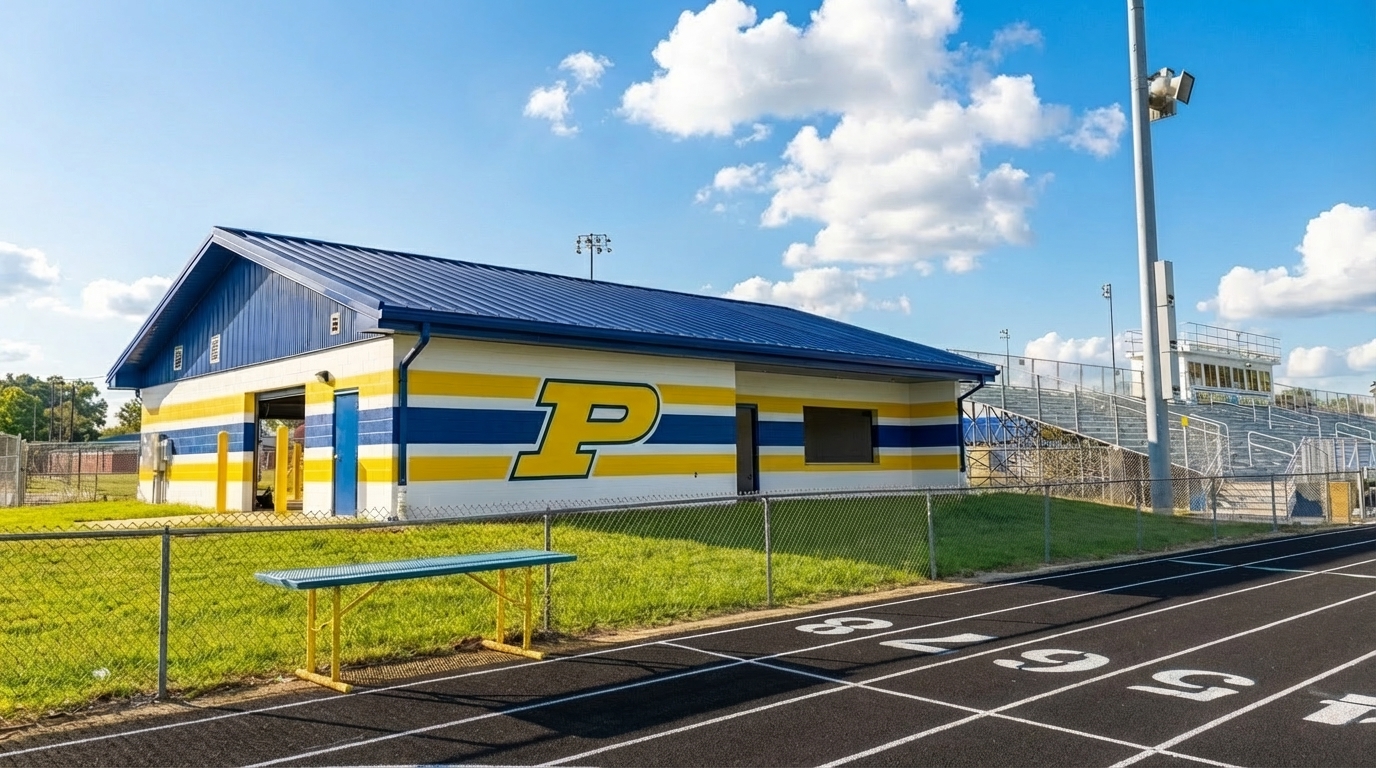
The fieldhouse at Princeton Middle and High School uses simple branding for a big impact.
At the fieldhouse at Princeton Middle and High School in Princeton, North Carolina, paint in the school colors of blue and gold transform this simple fieldhouse into a proud marker of school spirit beside the track and field. This modest example proves that impact doesn’t require extravagance, just intention.
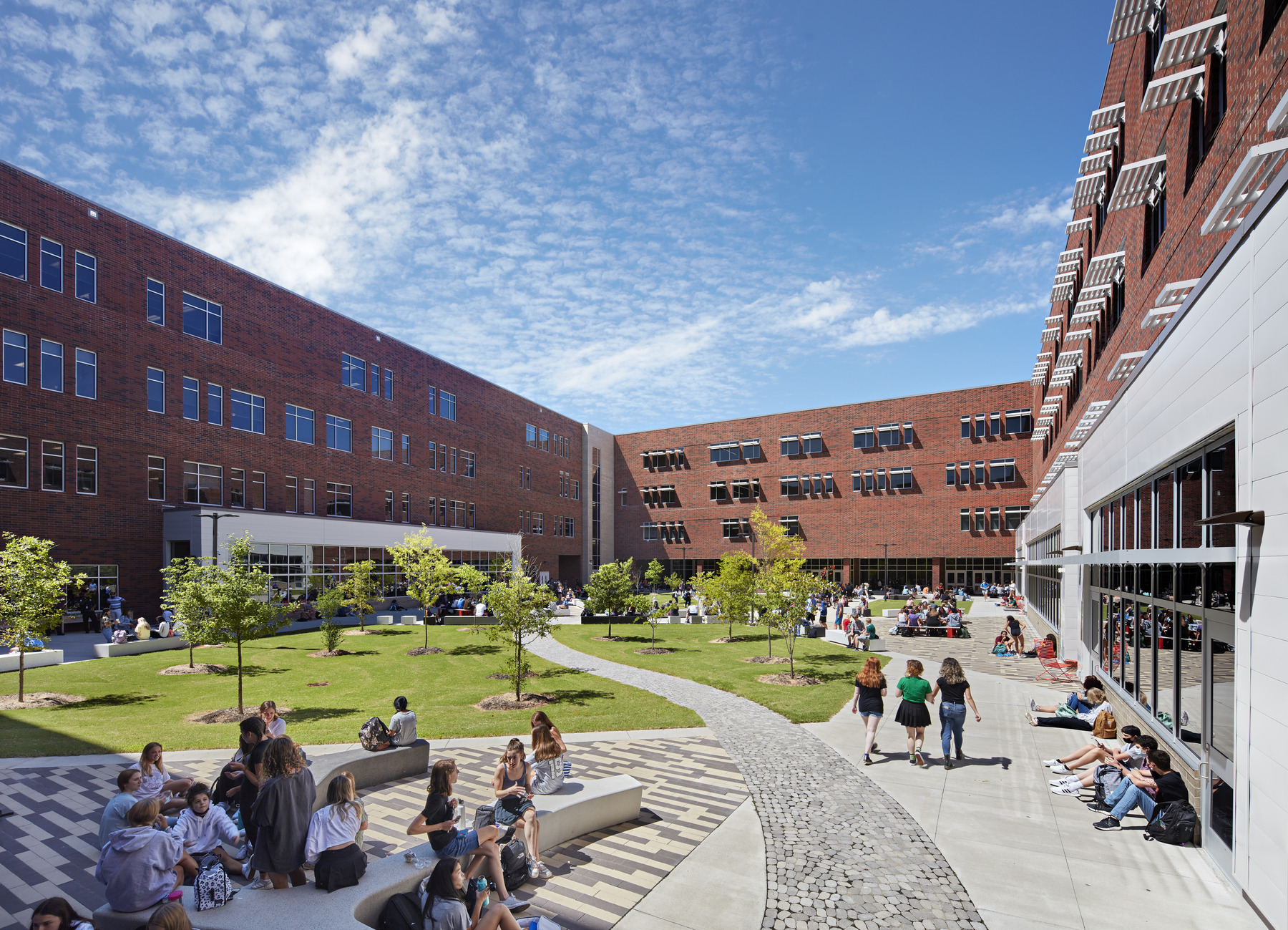
The courtyard at Apex High School is a thoroughfare for student life.
Stakeholders for the Apex High School replacement project made one thing clear early on: the interior courtyard had to stay. The original school’s courtyard had become a defining space—meaningful to students, faculty, alumni, and the broader Apex community. Keeping this element in the new design was about preserving a place where people felt connected to the school and to each other.
School branding is woven into the design of a building from the start. The choices we make about spatial sequences, materials, and even paint colors all contribute to how students, staff, and communities experience a school. When those choices are intentional, they do more than look good, they tell students this place is theirs. They connect today’s community to those who came before, and they create spaces where people belong. That’s the real work of design in education: not just building schools, but building identity.
Becky Brady, AIA, ALEP, CDT, LEED AP BD+C, is a Senior Architect and Associate Principal at Clark Nexsen with 20 years of design experience. Specializing in K-12 and educational design, she is a leading advocate for the creation of safe, engaging learning environments and partners with clients to develop solutions that respond to their unique educational needs. To speak with Becky, please email rbrady@clarknexsen.com or call 757.961.7703.
Nicole Simeonsson, AIA, WELL AP, is an Architect at Clark Nexsen with over 11 years of design experience. Specializing in educational, research, and industrial facilities, she creates functional spaces that enhance productivity and the user experience. To speak with Nicole, please email nsimeonsson@ClarkNexsen.com or call 919.576.2096.
