Ask an Architect: Damian Seitz on Clark Nexsen’s 10 Years with EVMS
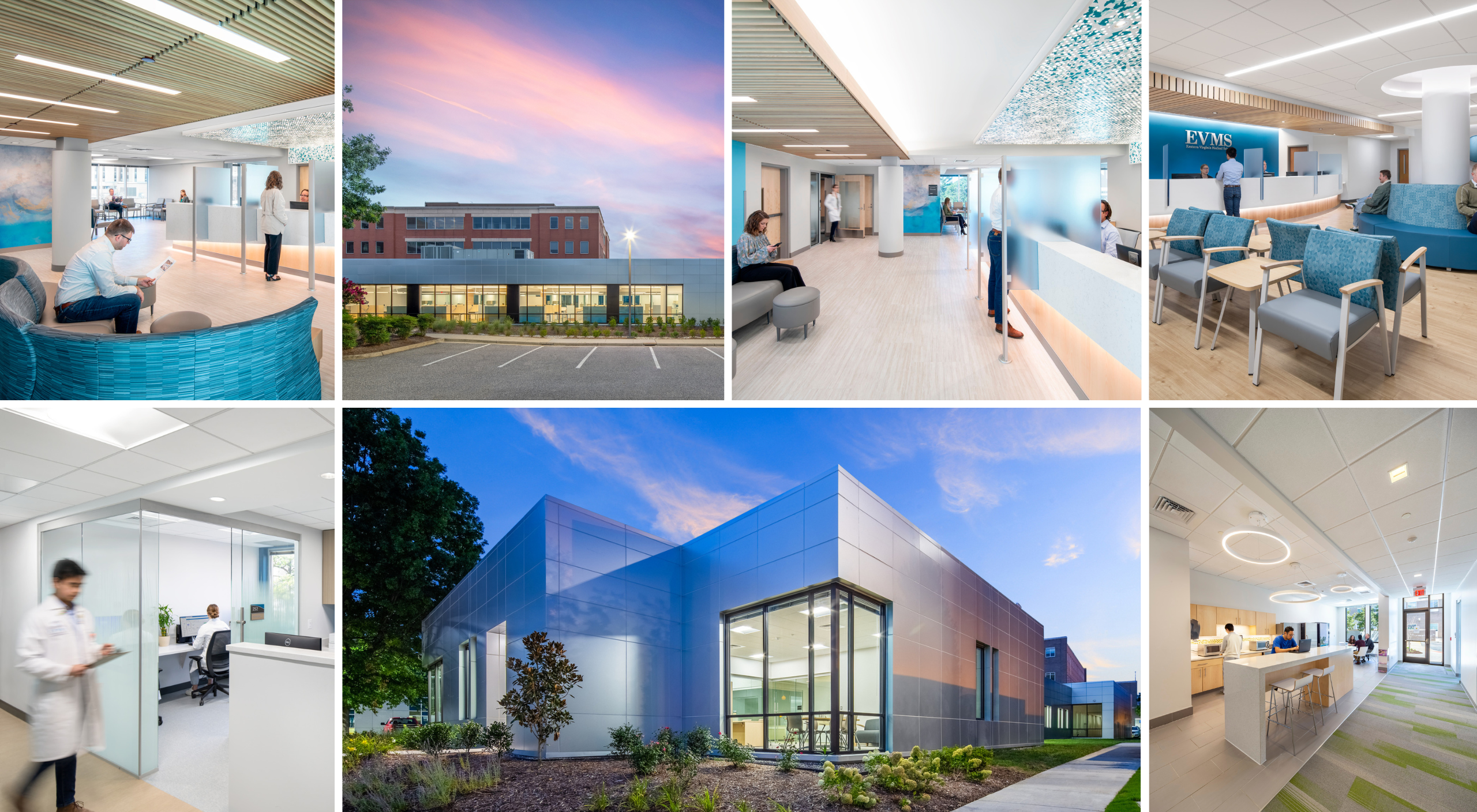
Damian Seitz, Principal, discusses Clark Nexsen’s decade-long relationship with Eastern Virginia Medical School (EVMS) and how the firm has helped their program and students with its projects.
When did Clark Nexsen start working with EVMS?
We started working with EVMS in 2015. They had a new director of facilities at the time and needed someone to provide an opinion on issues they were having with an existing facility. The director had previously worked for the Army Corps of Engineers and knew our firm from our extensive federal government work, so he gave us a call. I remember it being the day before Thanksgiving, and a lot of folks had already started a long holiday weekend. Nonetheless, we told him we could be there that day; 30 to 40 minutes later, we were on-site. We started by talking through the institution’s concerns and potential costs for renovations and repairs, but then we decided to think more wholistically about the building, the property, and the opportunity cost EVMS could realize if they had a need for additional space. Before you knew it, we were running multiple scenarios for replacement and expansion which ultimately led to the construction of the A-Wing at Williams Hall, housing the school’s Community Health and Research department. That initial conversation — moving from immediate problem-solving to strategic thinking — set the tone for what has become a 10-year partnership.

Clark Nexsen was responsible for the OB/GYN clinic renovations in Hofheimer Hall, which modernized the facility and provided new features for medical professionals and patients.
What type of work have we done for EVMS?
We’ve done a wide variety of projects with them: everything from initial planning studies, assistance with state funding documents, programming and concept design, complete gut renovations, to the full replacement of the previously mentioned A-wing. Most recently, we completed renovations on the first and second floors of Hofheimer Hall for their Ghent Family Medicine and Obstetrics and Gynecology clinics. Medical schools and allied health programs are an area where I feel like the firm really shines. The projects can take so many different forms, from simulation labs and functional clinics to more typical academic classrooms and collaboration spaces. I’ve always enjoyed the customization and nuance in projects that allow the end users to best function in the space. What I’ve learned over time is that medical education facilities aren’t just about meeting technical requirements; they’re about understanding how medicine is taught, practiced, and evolving.
What has the relationship been like over the last decade?
It’s been incredibly collaborative. The reason it works so well is that we approach every project, whether it’s a $500,000 renovation or a multi-million-dollar replacement, with the same rigor and desire to provide great spaces for patients, faculty, and students. EVMS’ leadership has trusted us like an extension of their own staff. Over time we’ve become true partners in their strategic planning, being brought in early, sometimes before they’ve even had budget approval, to help them think through space needs, discuss phasing strategies, and build the case for funding. That kind of trust doesn’t happen overnight. It develops project by project when you deliver on time, stay on budget, and genuinely understand the mission of medical education.
Being locally rooted definitely helps. Both of our organizations have been embedded in Hampton Roads for decades: EVMS for over 50 years, Clark Nexsen for 75. That shared commitment to the region created a natural alignment. But honestly, what has made the relationship special is working with people who are deeply dedicated to improving health outcomes and training the next generation of physicians. When your client’s mission is that clear, it inspires you to deliver your absolute best work.
How have we been able to leverage our expertise to help EVMS?
Medical schools sit at this fascinating intersection of healthcare and higher education, and you have to understand both worlds to design effectively for them. These aren’t just academic buildings — they’re clinical training environments where students learn by doing. That means spaces have to function as real medical facilities while also serving as teaching laboratories.
Take something as seemingly simple as an exam room. In a typical medical office, you optimize for patient throughput and provider efficiency. But in a teaching clinic, you also need space for a preceptor to observe, room for technology that allows remote observation, and acoustic privacy so conversations stay confidential even with students present. The mechanical systems have to support actual patient care — proper air changes, negative pressure isolation rooms for infectious diseases, medical gas systems — while also being accessible enough that students can understand how clinical environments actually work.
Being a full-service firm with in-house healthcare engineers enables us to integrate these complex systems from day one, with architects and engineers planning together rather than coordinating after the fact. For EVMS, that translated to one team that understood both the educational mission and the clinical requirements and had the experience to deliver both seamlessly.
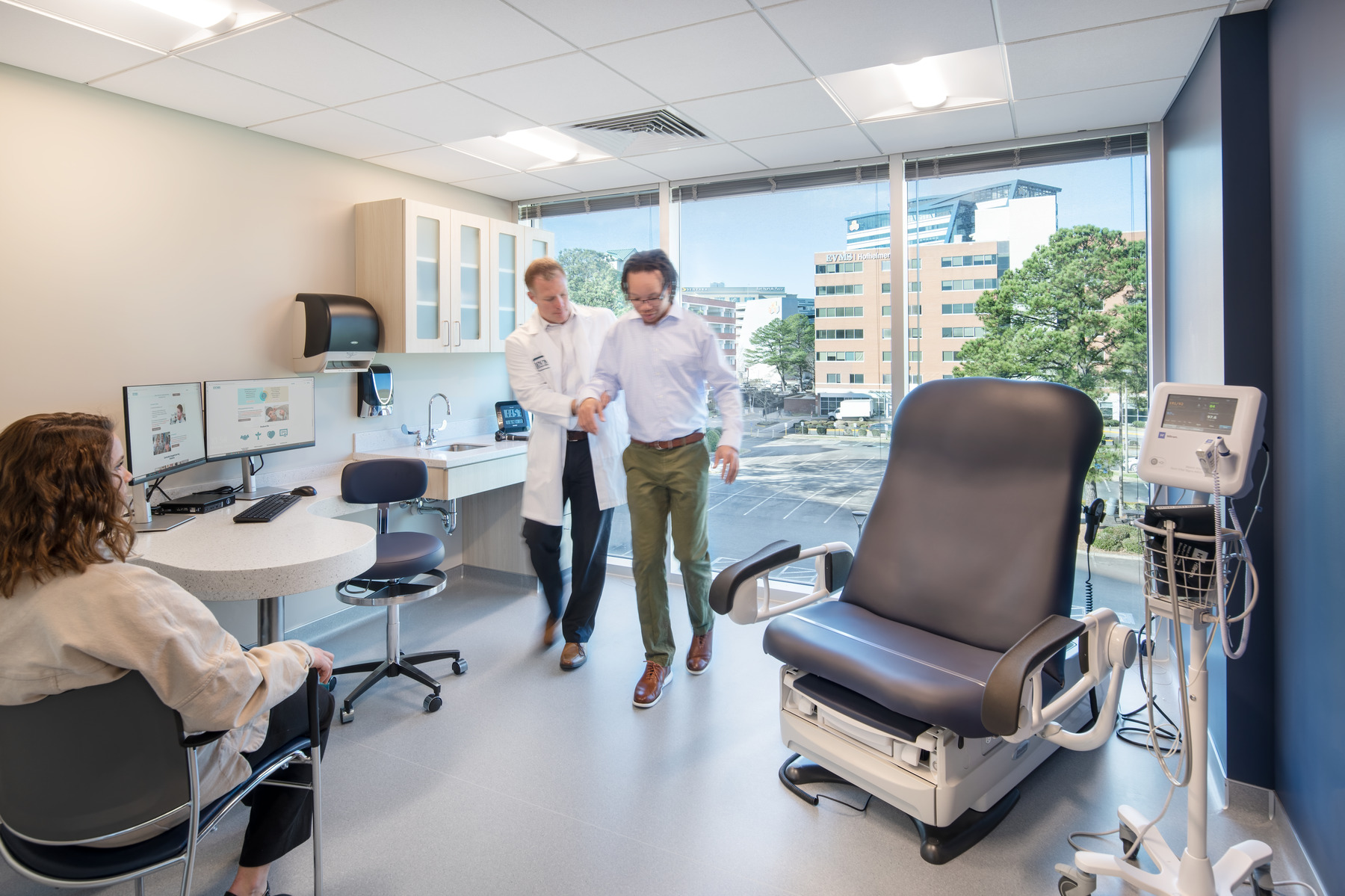
A gait lane is available in every exam room at the EVMS NeuroHealth Institute, allowing doctors to assess patients and provide diagnoses.
How are these facilities and projects different from one another?
On the surface, many of the clinics look similar — exam rooms, procedure spaces, nursing stations — but the design details reveal how medicine is practiced in each specialty. When we designed the EVMS NeuroHealth Institute, we needed larger exam rooms to accommodate gait lanes where neurologists assess how patients walk and move. For the OB/GYN clinic, the care model was completely different: instead of one centralized physician work room serving the entire floor, they wanted decentralized pods with individual care teams, reflecting a shift toward more personalized, team-based care that we’re seeing across women’s health.
These aren’t just aesthetic choices; they’re about understanding clinical workflow, patient privacy, and how care teams actually function. A family medicine clinic operates differently than a specialty clinic. Teaching spaces have different technology and observation requirements than pure clinical spaces. Even our work on Brickell Library — creating a quiet lounge where faculty could have informal conversations away from the demands of clinical and teaching schedules — addressed a real need: space to think and connect as colleagues, not just as care providers.
What’s made our work successful is recognizing that each project is a chance to listen carefully, understand the specific needs of that department or specialty, and translate that into space that actually works for how they practice and teach medicine.

In addition to faculty collaboration space, renovations to the EVMS Brickell Library added much needed improvements to preserve the school’s History of Medicine collection.
What are some of the challenges of doing a renovation compared to a brand-new facility or building?
Renovations demand a different mindset. With new construction, you’re working from a clean slate. With renovations, you’re working with an existing structure, systems you can’t always see, and facilities that need to stay operational while you’re working in them. You can’t shut down a teaching clinic during the semester or close exam rooms when patients have scheduled appointments.
The hidden conditions are always the wild cards. On one EVMS project, we opened up walls and discovered structural concrete beams that were spalling heavily. Water had been getting into an expansion joint for years. You simply can’t predict everything until demolition starts. What separates good teams from great ones in those moments is how quickly you can assess the situation, pull the right expertise together, and provide a solution that keeps the project moving. In that case, we remediated the rust, fixed the conditions causing the spall, and kept the schedule on track.
The key to successful renovations is going in with your eyes open: budget for contingencies, communicate constantly with the client about what you’re finding, and have a team that can pivot quickly when surprises inevitably surface. That adaptability is even more crucial in medical and academic environments where downtime has real consequences for patient care and student learning.
Looking back on all the work we’ve done at EVMS, what do you hope all these projects have achieved?
What’s exciting is seeing how these projects compound over time. Individually, a clinic renovation or a new academic wing might seem modest. But cumulatively, they’ve transformed how EVMS functions as both an educational institution and a healthcare provider.
Better facilities create a virtuous cycle. Modern, well-designed clinical spaces help recruit exceptional physicians and faculty. Those physicians provide higher-quality patient care and become better teachers and mentors. Students training in contemporary environments with current technology are better prepared for actual practice when they graduate. And when prospective students and faculty visit campus, they see an institution that’s investing in its future, which makes EVMS more competitive in attracting the next generation of talent.
This is what strategic, sustained investment in facilities can do for an academic medical institution. It’s not just about nicer buildings — it’s about creating an environment where excellence in education, research, and patient care can thrive. That’s what we’ve worked toward with EVMS over the past decade, and it’s the kind of long-term partnership and impact we hope to create with other institutions committed to advancing medical education and healthcare.
